Picture a Manchester fashion label that sees a viral TikTok clip from São Paulo before breakfast. This is a DIY upcycled denim jacket tagged #recycleddenim. At 10 am, a trend-alert tool powered by artificial intelligence notifies the supply chain module of the brand, which in turn changes the order automatically with the manufacturer in Vietnam. At 2 pm, there is a hyper-personalised campaign on Instagram that shows the new jacket to people who liked similar things. Within hours, the limited run sells out. This isn’t fiction. The success comes from two tightly-linked systems: social media marketing (SMM) and AI, which turns real-time social data into products, profits, and customer loyalty.
The speed at which artificial intelligence has migrated from research labs to boardroom priority is remarkable. A team of researchers at the Massachusetts Institute of Technology calls it “the most important general-purpose technology of our era” (Brynjolfsson and McAfee, 2017, cited in Buxmann et al., 2021). The Forbes magazine conducted a survey according to which, almost all senior executives (95%) think that artificial intelligence will soon become essential for their companies. Moreover, the McKinsey Global Institute estimated that AI might bring about an additional $13 trillion to global GDP by 2030 (Forbes Insights Team, 2018; Bughin et al., 2018, both cited in Buxmann et al., 2021). Today’s management information systems, powered by artificial intelligence, already cater to dynamic pricing in airlines and predictive maintenance in manufacturing plants. Yet the same black box algorithms that generate these gains also create serious problems. Police use facial-recognition systems that violate privacy, clinical decision tools show racial bias, and court-support systems that work in a black box manner raise questions of fairness (Rezende, 2022; Vyas et al., 2020, both cited in Dennehy et al., 2023). When social media platforms spread misinformation or polarising content at a large scale, all algorithm systems lose public trust (Janssen et al., 2020, cited in Dennehy et al., 2023). Having responsible AI is necessary for the $13 trillion dream to become a reality rather than a nightmare.
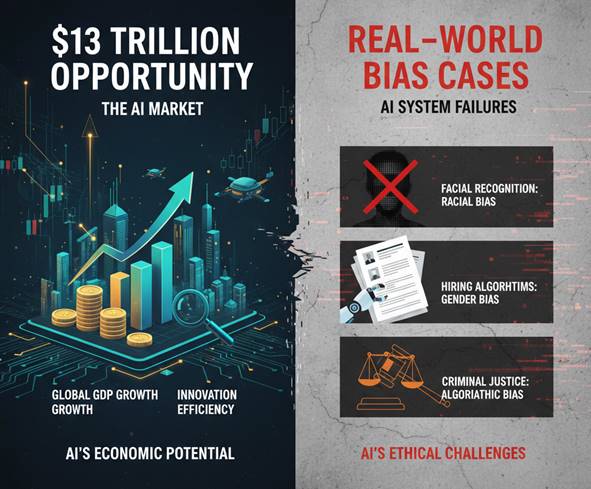
Adapted from: Buxmann et al. (2021)
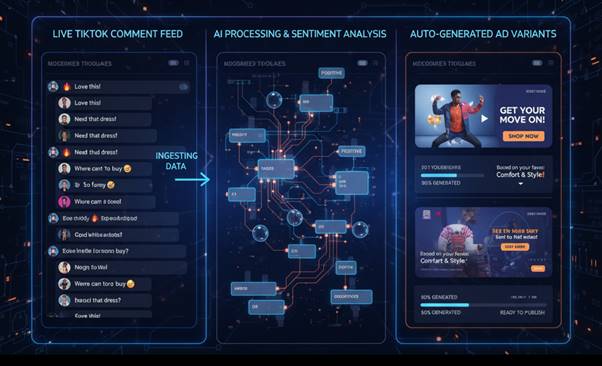
When generative A. I get integrated with SMM, and the system becomes predictive and generative. According to Chyrak et al. (2024), AI tools are now capable of scraping public social data, detecting micro-trends before they proliferate, capturing emotional sentiment in real time, and generating tailored visuals or ad copy that has maximum conversion efficiency. Yet this power raises serious ethical concerns. The algorithms that boost sales can also spread misinformation, take advantage of unpaid creative labour, or worsen bias. For instance, in 2025, Christie held an auction for AI-generated art that was sold for $730,000, whereas 4,000 artists protested as the work was trained on their work without consent (Jones, 2021). Many are getting worried about the implications of AI chatbots. After all, most of these chatbots depend on the content generated by human creators (Ayokunmi et al., 2025). One open letter stated, “Your support of these models rewards mass theft of human artists’ work.” It also noted that without transparency, these systems risk undermining the very trust they depend on
The bottom line is straightforward. The use of artificial intelligence, in conjunction with social media marketing, is one of the most powerful information systems that most organisations will deploy in the course of this decade. Speed, insight, and reach are previously unimaginable to generations of management. In my view, formed both by the literature and late-night discussions with coursemates, it’s the ones who view ethics and transparency as competitive advantages rather than compliance burdens who stand to win. Ensure that algorithms are designed to enable explainability and that bias audits take place on a regular basis. Use social channels for authentic two-way engagement with customers, not one-way broadcasting (Dennehy et al, 2023; Ayokunmi et al, 2025; Chyrak et al, 2024). When firms take action to make a positive impact, not only do they grow, but they also continuously earn the right to keep growing as technology scepticism spreads. Essentially, this is the overall digital transformation problem.
References
Ayokunmi, L. A., Seman, N. A. A., Rashid, U. K., & Mohamad, A. (2025). The role of social media marketing as an ICT tool in improving supply chain sustainability of SMEs: A systematic literature review. Procedia Computer Science, 253, 1392–1401.
Buxmann, P., Hess, T., & Thatcher, J. B. (2021). AI-based information systems. Business & Information Systems Engineering, 63(1), 1–4.
Chyrak, I., Koziuk, V., Siskos, E., & Darvidou, K. (2024). Comprehensive framework for social media marketing (SMM) strategy for effective business activity. Socio-economic relations in the digital society, 4(54), 39–58.
Cygnis Media Editor. (2025, January 21). How AI-powered management information systems are revolutionising business operations. Cygnis.
Dennehy, D., Griva, A., Pouloudi, N., Dwivedi, Y. K., Mäntymäki, M., & Pappas, I. O. (2023). Artificial intelligence (AI) and information systems: Perspectives on responsible AI. Information Systems Frontiers, 25(1), 1–7.
Jones, B. (2021, April 15). Assessing the impact of social media on marketing information systems. LinkedIn.
 Site Title
Leave a comment